




Staff Writer
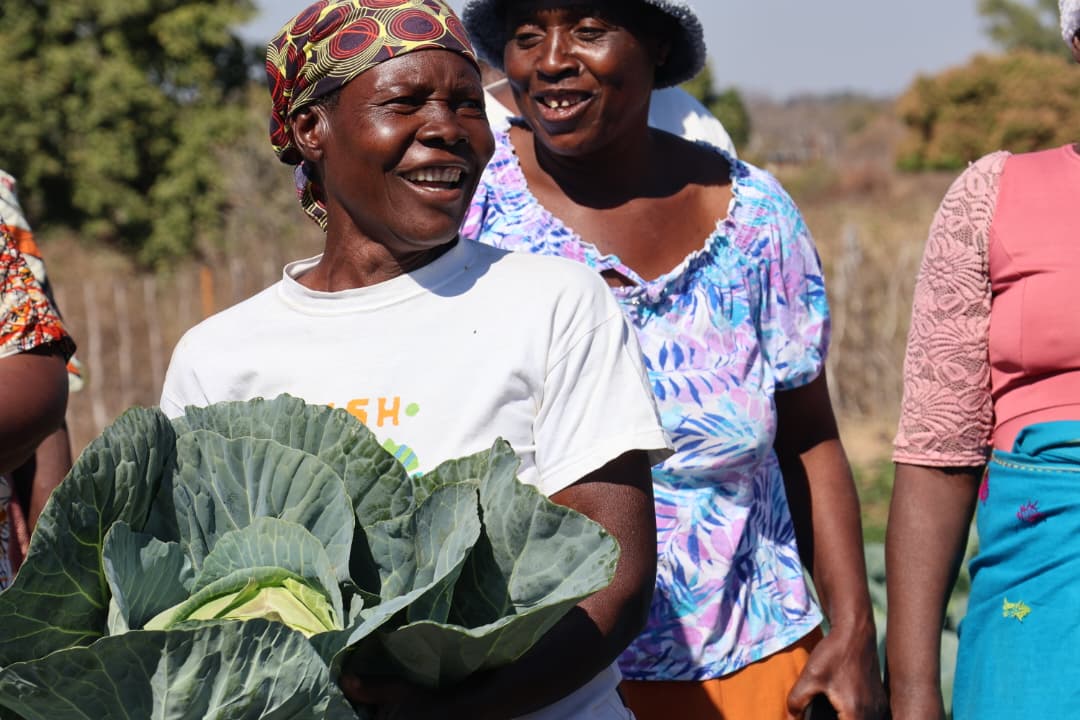
MRS Nyaradzo Dzawanda could hardly contain her excitement as she proudly held up a freshly harvested cabbage at Virira Village Business Unit in Chivi, a simple harvest that she says represents how access to water and organised production is changing life for women in her community.
For years, vegetables were something villagers had to travel long distances to find, while unreliable access to water made sustained agricultural production difficult.
Now, the sight of freshly harvested produce at the village business unit is becoming increasingly common.
For Mrs Dzawanda and other women working at the VBU, the harvest is not only about putting food on the table, but also creating an opportunity to earn income and meet household needs.
“We want to thank the Government. Our lives are no longer the same,” she said.
“We no longer travel long distances to access water. We no longer have to travel to Masvingo or Zvishavane to buy vegetables. We have been selling green mealies since 2024 when the VBU was established.”
Her experience reflects a broader shift taking place at Virira, where women have become the dominant force behind the community-led agricultural project.
Of the 37 members at the Ward 11 VBU, only seven are men, highlighting the growing participation of women in collective agricultural production.
Agricultural Planning and Development Director Mr Leonard Munamati said the growing involvement of women demonstrated the wider economic potential of Village Business Units, particularly in communities where women carry much of the responsibility for household welfare.
“Village Business Units also empower women. Already, we know that in this country, women are the majority of the population. So, when we empower women, we have actually empowered the whole community, be it at village level, at ward level, or as a country,” he said.
“If we empower women, we have empowered the whole nation.”
Mr Munamati said income generated through the projects was giving women greater financial independence while enabling them to contribute directly towards household expenses.
“In this Village Business Unit, we have seen that almost the whole committee is made up of women. These women now can get their own money without waiting for money coming from the father or their husbands. They can also get their money and be able to support their own families,” he said.
For communities such as Virira, the availability of water has been central to that transformation.
The VBU is supported by a solar-powered borehole, providing water for agricultural production while also easing the burden of accessing water for domestic use.
Mr Munamati said the combination of water availability, organised production and women’s participation was helping communities move beyond subsistence farming towards income-generating enterprises.
The model is also contributing to household nutrition, with villagers able to produce vegetables and other crops locally rather than relying entirely on purchases from distant urban centres.
Ward 11 councillor Mr Danmore Jaka said the initiative had helped communities regain their productive capacity while allowing villagers to determine projects according to their own needs.
“We would like to thank the Government for coming up with this community-led initiative as we see our people leading the projects in line with their needs,” he said.
“For years, people have been struggling to access water for drinking and irrigation, but with Village Business Units, our lives have been transformed. We are now seeing parents being able to pay school fees for their children through the proceeds of this VBU.”
The experience at Virira illustrates how investment in basic infrastructure can have effects extending beyond agriculture.
A borehole that provides water for a garden can simultaneously reduce the distance travelled by women and children seeking water, improve household food supplies and create an avenue through which families generate income.
For women such as Mrs Dzawanda, however, the transformation is perhaps best measured in what can now be harvested from the land.
Her cabbage, freshly lifted from the VBU garden, represents more than a single vegetable.
It is evidence of a community increasingly able to produce its own food, sell surplus produce and use agriculture as a foundation for improving household livelihoods.
As Government expands Village Business Units, the experience of Virira suggests that placing women at the heart of community agricultural enterprises could be central to turning rural production into a stronger engine for household incomes, nutrition and local economic development.