





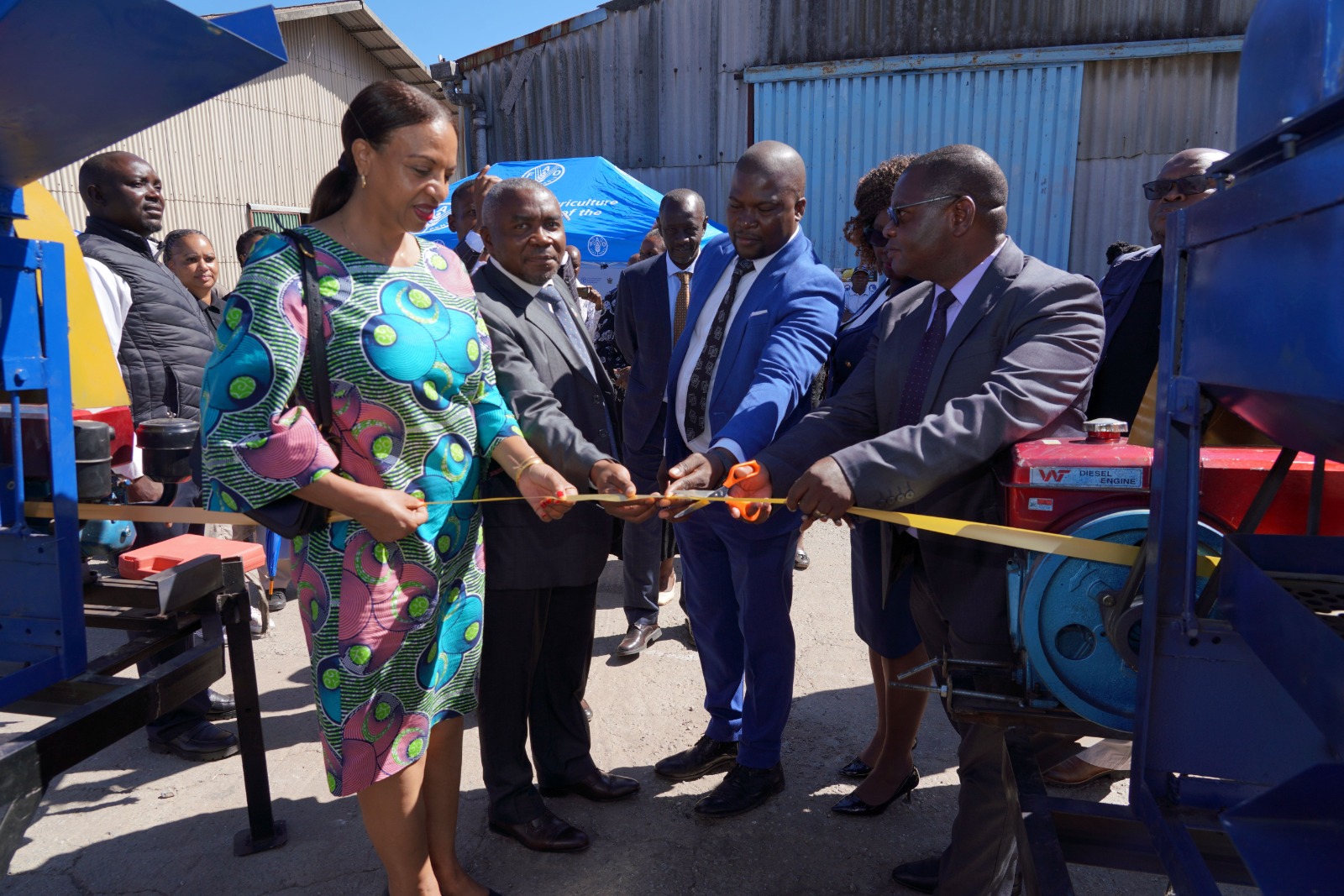
Zimbabwe has taken a significant step toward reducing food losses and strengthening agricultural resilience following the handover of post-harvest equipment under the Zimbabwe Emergency Food Production Programme.
On Tuesday, Food and Agriculture Organization of the United Nations in partnership with the African Development Bank and the Government of Zimbabwe, implemented an initiative which is part of the African Emergency Food Production Facility, a continental response to a worsening global food crisis driven by climate variability, supply chain disruptions, and rising production risks.
Speaking during the handover, FAO Subregional Coordinator for Southern Africa and FAO Representative in Zimbabwe, Patrice Talla, said the programme marks a critical shift from increasing production to safeguarding harvests.“Increasing production alone is not sufficient if we are unable to protect what farmers harvest. Post-harvest losses remain a significant constraint, particularly for smallholder farmers, ” Talla said.
Tackling “silent losses” in agriculture Zimbabwe continues to face high levels of post-harvest losses, undermining food security and farmer incomes.
According to Permanent Secretary in the Ministry of Lands, Agriculture, Fisheries, Water and Rural Development, Obert Jiri, the country loses up to 28% of maize and as much as 45% of vegetables after harvest.
“Post-harvest losses have been a silent thief to our food systems. This is unacceptable for a nation that has declared food sovereignty as a non-negotiable objective, ” said Prof Jiri.
The equipment handed over includes 2,100 metal silos, 70 multi-crop threshers, and five combine harvesters tools expected to significantly reduce losses caused by poor storage, pests, and inefficient processing.
Women and smallholder farmers at the centreThe programme places strong emphasis on smallholder farmers, particularly women and youth, who are central to Zimbabwe’s agricultural sector but often lack access to mechanisation and storage technologies.
AfDB Country Manager for Zimbabwe, Eyerusalem Fasika, highlighted that the intervention is designed to ease labour burdens and improve productivity.
“These technologies are designed to reduce labour, particularly for women, and enhance incomes for smallholder farming households,” she said.
Women provide more than 60% of agricultural labour in Zimbabwe, yet they remain disproportionately affected by post-harvest losses and limited access to equipment.
Climate resilience and food systems transformationThe programme comes at a time when Zimbabwe is grappling with increasing climate shocks, including droughts and erratic rainfall, which have heightened food insecurity risks.
By investing in storage and processing technologies, the initiative aims to build resilience not only at household level but across the national food system.
“This is not just about equipment. It is about safeguarding harvests, strengthening livelihoods, and building a food system that is resilient and capable of feeding the nation.”said Talla.
The intervention also aligns with AfDB’s “High 5s” priorities, particularly “Feed Africa” and “Improve the Quality of Life for the People of Africa,” which focus on food security, agro-industrialisation, and inclusive economic growth.
From subsistence to agribusinessGovernment officials say the equipment will play a key role in transforming agriculture into a viable business sector under Zimbabwe’s Agriculture Food Systems and Rural Transformation Strategy.
Jiri emphasised that reducing post-harvest losses directly translates into increased incomes without expanding farmland.“Every metal silo is a business asset. Every thresher is a tool for enterprise. Every combine harvester is a productivity multiplier,” he said.
The government aims to reduce post-harvest losses from 16.5% to 6% by 2030 while increasing agricultural mechanisation levels from 43% to 80%.
The initiative is said to promote farmer-based organisations and shared-use models to ensure broader access, particularly for vulnerable households.