




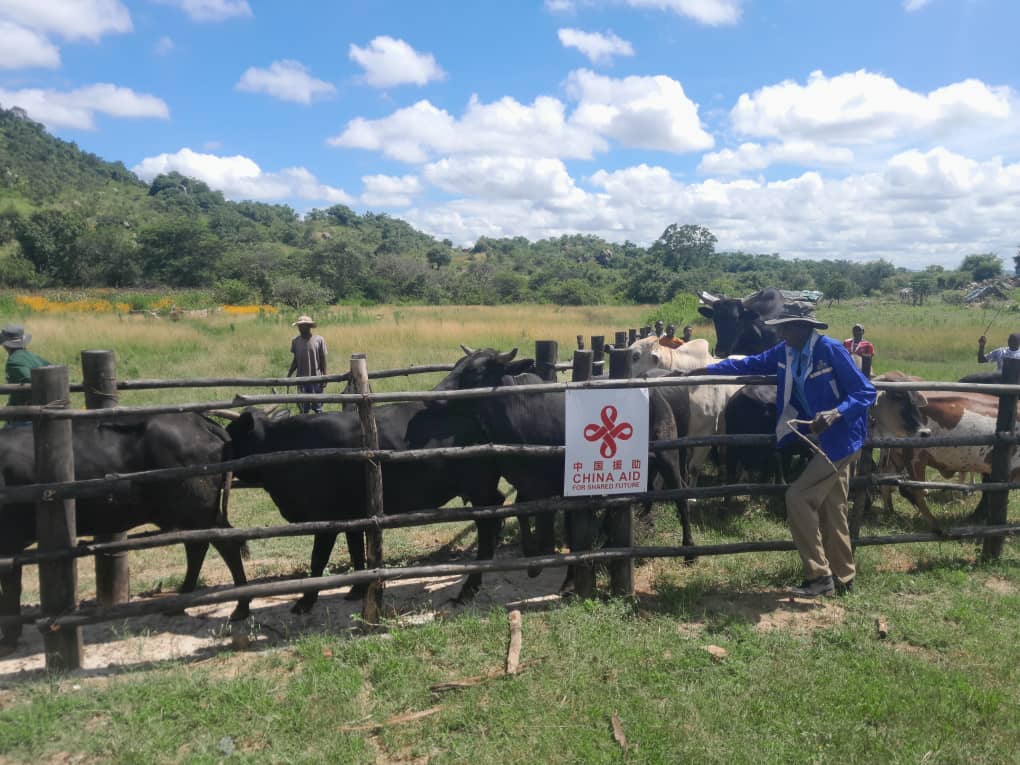
The Government of Zimbabwe, in partnership with China Aid, has commissioned the rehabilitation of Bushu Dip Tank in Shamva District, a development expected to strengthen livestock disease control and improve rural livelihoods in Mashonaland Central.
The dip tank, located under Chief Bushu in Chikonda Zone, was officially handed over during a completion ceremony for the China-Zimbabwe Agricultural Cooperation Projects, attended by government officials, technical experts, and local farmers.
The project, jointly implemented by the Department of Veterinary Services and China Aid, included practical demonstrations on livestock health management such as acaricide premixing, cattle dipping, tick grease application, pour-on treatments, dog vaccination, and livestock register maintenance.
Chief Director in the Department of Veterinary Services, Dr Pious Makaya, said, “the rehabilitation of the facility comes at a critical time when farmers are battling tick-borne diseases that continue to affect cattle productivity across the country.”
Speaking at the same event, team leader of Chinese Agricultural Expert Group Dr. Zhao Ke said the upgraded dip tank is now equipped to meet key animal health requirements.
“It is a great pleasure to join you today for this significant moment the completion ceremony of our agricultural cooperation projects,” said Dr Zhao.
“We have comprehensively upgraded and renovated this cattle dipping tank. The facility can now support epidemic prevention services, including dipping, diagnosis, treatment, immunisation, and sampling for up to 600 cattle, ” he added.
Dr Zhao said the initiative goes beyond infrastructure development, focusing on improving farmer incomes and strengthening agricultural systems through knowledge transfer and technical support.
He revealed that under the broader cooperation programme, two agricultural demonstration villages have been established in Zimbabwe to promote sustainable farming practices.
In Zvimba District, Mashonaland West, a poultry hatchery centre is now producing more than 2,000 day-old chicks per month, benefiting over 300 households. Some farmers involved in free-range poultry production are reportedly earning up to US$400 per month.
In Zindi Village, also in Shamva District, the project has delivered an irrigation system with a daily water supply capacity of 55,000 litres, alongside poultry runs and a greenhouse. The infrastructure is supporting diversified farming activities, including crop production, cattle rearing, and poultry farming.
Additionally, Shamva Agricultural College has been equipped with a poultry hatchery facility to support local farmers with egg incubation services.Dr Zhao said capacity building remains a key pillar of the partnership, with more than 1,400 trainees across Zimbabwe receiving practical training in areas such as animal husbandry, veterinary services, horticulture, irrigation, and agricultural mechanisation.
“These achievements would not have been possible without the strong cooperation between the Ministry of Lands, Agriculture, Fisheries, Water and Rural Development, local authorities, and farming communities,” he said.
He added that plans are underway to expand the demonstration village model to other rural areas, with the aim of reaching more smallholder farmers.Local farmers in Shamva are expected to benefit from improved livestock health management, reduced cattle mortality, and enhanced productivity as a result of the upgraded dip tank and ongoing technical support.
A beneficiary, identified as Mr Jiti in Shamva who spoke to the media commended the China-government efforts saying the help is timely and much needed.
“We are happy with this project, it is time because we have lost so many cattle, but the drip tank is here to rescue,” he said.


